Working With Clay
Page Wilson
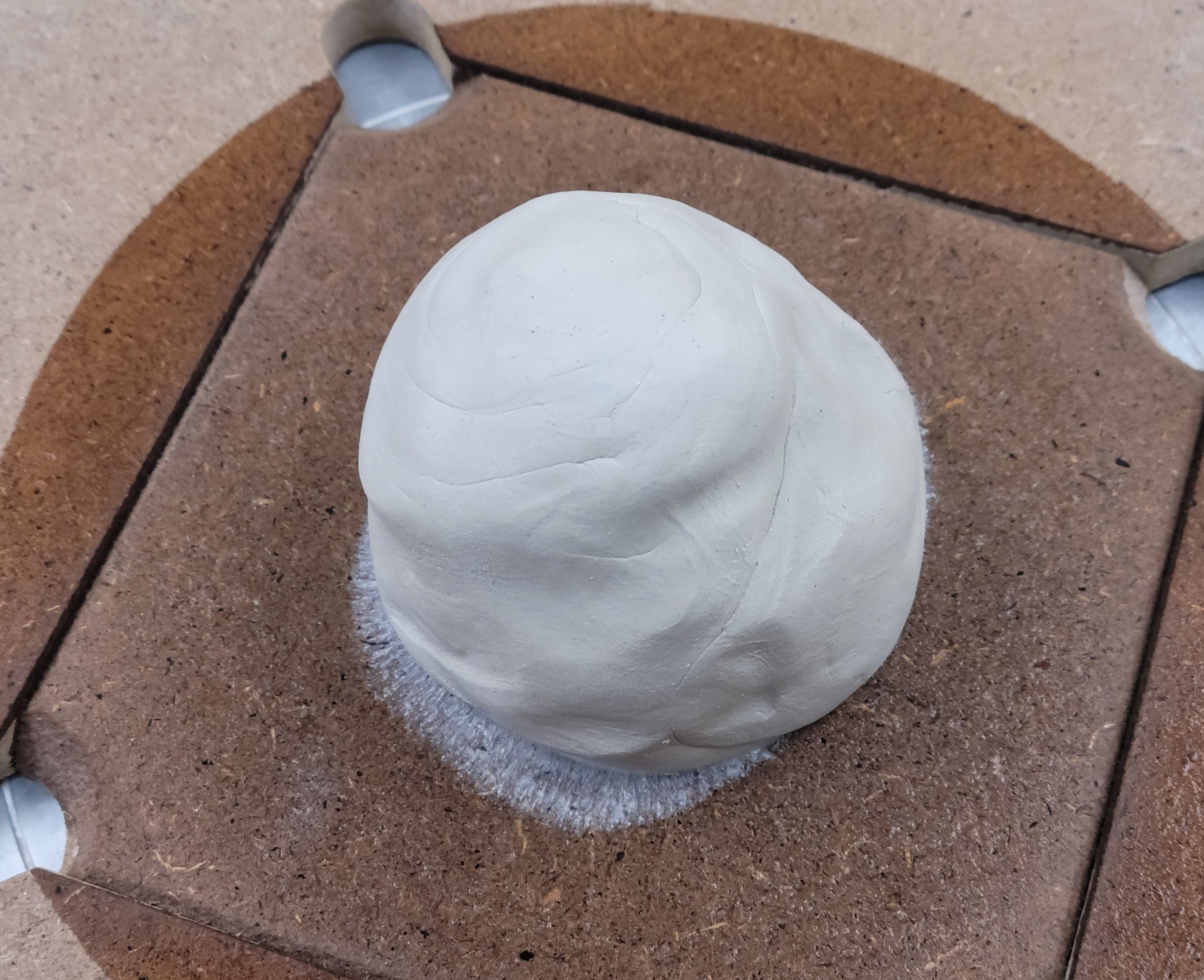
Firstly, shout out to my advisor, Clay(ton Shonkwiler). Secondly, this article is about ceramics.
Clay can be difficult to work with. As an overview, you start with wet clay and the amount of details you are able to add depends directly on how dry/wet your clay is, so you have to be careful to add the right details at the right time. There are in fact, many spots where one can mess up their piece. Making pottery is generally classififed into two categories, handbuilding and throwing on a wheel. My favorite kind of pottery is when you throw something on the wheel then add a handbuilt piece onto it afterwards, like throwing a cylinder then adding a handle to make a mug. Or throwing a vase and sculpting a flower by hand to add to the side.
Once fully dry, we say your piece is ``greenware." When fired in the kiln, it becomes ``bisqueware." Then you can add a glaze and fire it again, giving it extra color and cool designs.
...
Advice From Tori
Dear Tori
Who are you?
Sincerely, Confused Torus Reader
Dear Confused Torus Reader,
I understand the confusion! As a new Torus addition, I am here to help you when you need help. Send me your serious, or non-serious, advice questions and I will do my best to provide some answers.
Love, Tori
...
Piranesi: Reflections on a House of Statues
Miguel Andrade
Piranesi is a novel about many things, memory, art, mathematics, academia but most importantly
beauty. Piranesi lives in a house, potentially an endless one, filled with statues that line the walls of
the vestibules and halls that he traverses. These statues depict everything ranging from the fantastical
(angels and Minotaurs), the quotidian (people reading books or standing around) to the allegorical
(Piranesi favors a statue of a gorilla as a symbol of strength and courage). Much like our main
character can recognize that these statues represent things that are not of this world, the reader can
always glimpse at reflections of other worlds within the novel.
...
SIAM Students Visit NCAR in Boulder!
Kristina Moen
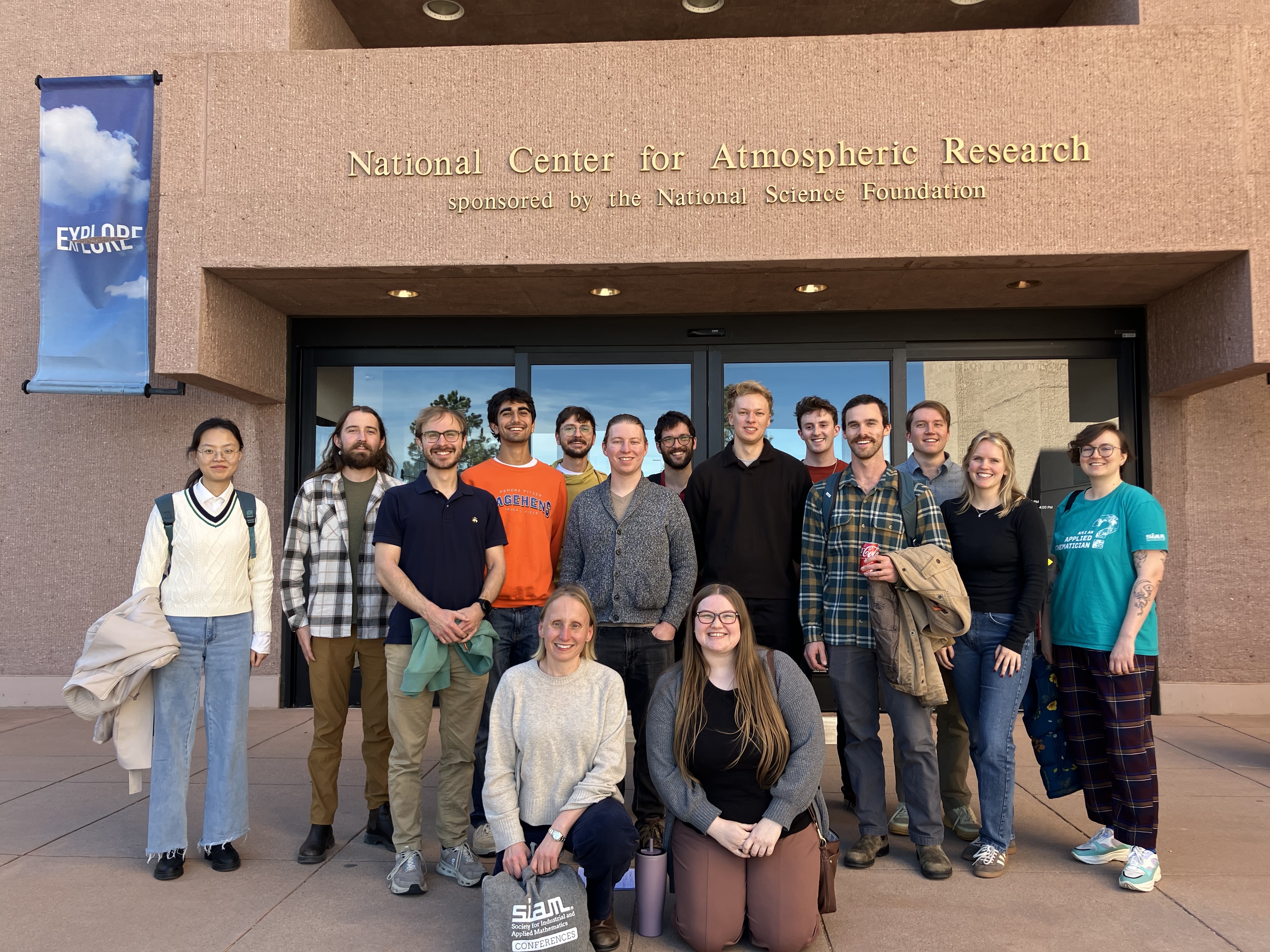
On February 5th, student members of the Society for Industrial and Applied Mathematics (SIAM) stepped inside one of the nation's premier hubs for atmospheric science: the National Center for Atmospheric Research (NCAR) in Boulder. Organized by the SIAM student chapters of CSU and CU Boulder, the daylong visit brought together graduate students from both institutions to explore how mathematics informs contemporary atmospheric science and learn about the role of national research centers in sustaining long-term scientific infrastructure.
They met at NCAR's iconic Mesa Laboratory, which is set against the Boulder Flatirons. Designed in 1961 by architect I.M. Pei, the building seems to rise from the sandstone cliffs and is a testament to the interplay of science and environment. Inside, researchers work across fields ranging from meteorology and atmospheric chemistry to solar and space weather.
...
A Statistical Verification of a Consiricy
Ian Jorquera
What makes someone back-in when they park in a parking spot? For me I simply could not be bothered to spend the time and mental energy to back-in when parking. So what drives those who do? And what type of person chooses to back-in given the chance?
I have personally noticed that one particular group of people who tend to back-in quite regularly are those who drive pickup trucks. Until recently, I had nothing more then my intuition and my keen sense of perception to justify this, which is what lead me to write this piece.
While writing and collecting data for this piece the authors become aware of a recent piece in the New York Times titled ``Do You Back Into a Parking Spot or Back Out?'' Much like this piece, they explore the often under-looked ``ideological division'' of backing-in or backing-out of a parking spot. The authors much like our selves speculate that a predominant reason for backing-in is for a quick escape: either from possible treats, from a grueling job, or just for the convenience of leaving more quickly. One interviewee believed that backing-in is ``mostly men showing off ... and it seemed ... that a disproportionate number of them drove big American work trucks.'' Althought the same NYT article claims that such a habit ``didn't seem to be shaped by gender or car make,'' our research seems to agree more with this interviewee and disagrees with the conclusions of the NYT piece.
...
A Q&A with Associate Professor Clayton Shonkwiler
Lisa Streeb Case
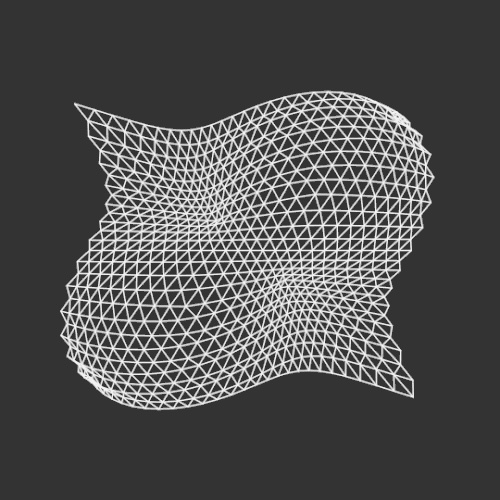
While trying to illustrate a point in a lecture, Associate Professor Clayton Shonkwiler of mathematics created his first mathematics animation. Now, years and hundreds of GIFs later, Shonkwiler's math-inspired artwork has become a dedicated hobby, leading to art exhibitions and innovative teaching curriculum.
What is your background in mathematics?
My training is in differential geometry, which, for example, is the math behind general relativity, and so the idea there is to understand the shape of spaces. These days I call myself an applied geometer: I work with a physical system that someone is interested in and take all the possible states of that system and think of those as points in the space. The goal is to understand the geometry of that space, which in turn gives us information about the system.
...
Opinion: Adult Responsibilities with Child-Like Restrictions
As most of us are aware, a new personal leave policy---specifically aimed at graduate students---has been implemented in the math department. As graduates, we are extremely disheartened by the details of this policy. We are not calling for the absence of a policy, but rather one that is more reasonable. As it stands, the new policy is a breach of our privacy. It requires specific reasons for any number of absences, even if we want/need to miss only one day of class. Of course, if someone is abusing the flexibility of our job, scrutinizing their absences makes sense. However, this blanket policy is one that signifies a lack of trust in both our commitment and judgement as instructors and researchers.
It is known that graduates at CSU are in a unique position as primary instructors for undergraduate math courses, something that is not common in other departments or at other universities. In fact, for many of us, this was an influencing factor to join CSU's program.
...
Matthew Williams
"Please tell me inner tube water polo is a real thing and that it's as hilarious to watch as it sounds."
"Oh it's definitely real and exactly as ridiculous and glorious as it sounds."
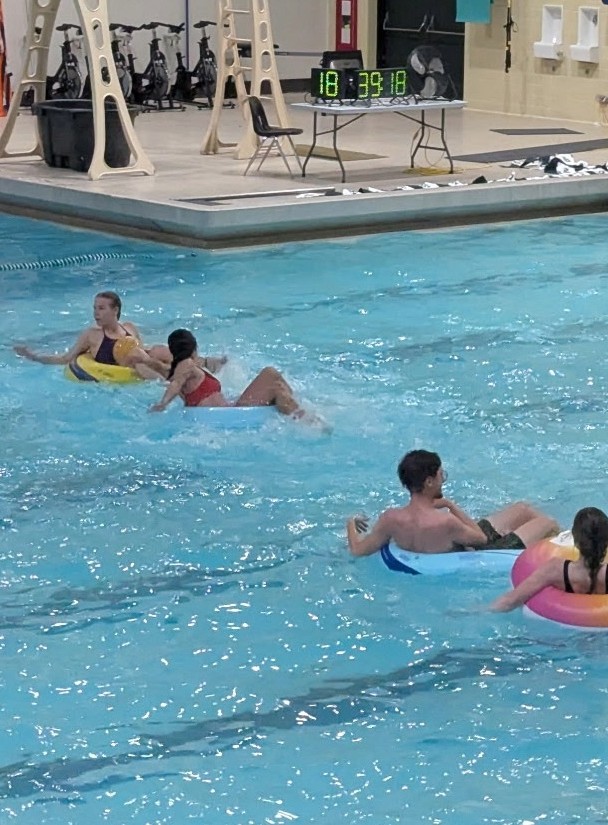
Those were the first words I ever shared with my partner Mattea when we matched on Bumble almost two years ago. I brought her to a game on our fifth date, and she's been cheering us on ever since. As silly as it sounds, inner tube water polo has been a huge part of my life and, along with Mattea, helped me through the last year of my PhD. Writing my dissertation in the office was miserable most days, but being able to take breaks to strategize the next game with other grads kept me going.
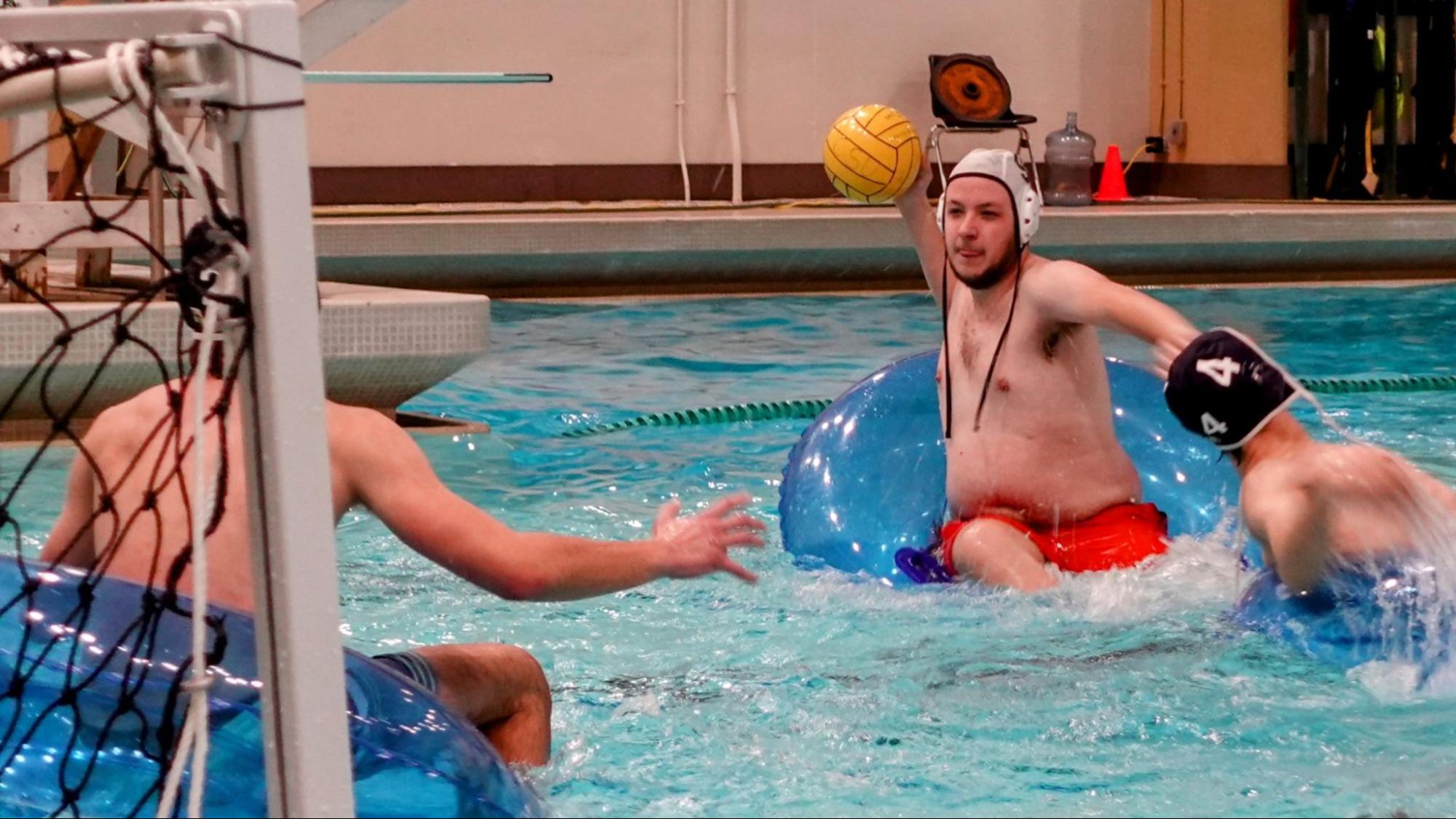
If you've never seen a game before, it plays out like water polo, except all the players sit in inner tubes, and that one change makes the game so much more accessible and absurd. For graduate students in the math department at Colorado State University, inner tube water polo has been a staple for more than a decade, spanning 21 teams and 67 players, including students, alumni, partners, and friends of the department.
Read the full article.
New Knot News!
James Fantin-Hardesty
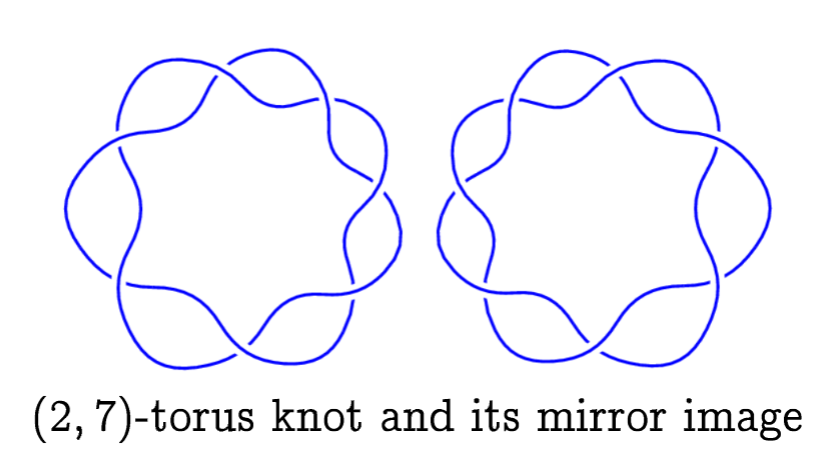
A decades old knot theory conjecture has been unraveled. The conjecture asks, is the unknotting number (the number of crossing changes (or "cuts") needed to transform a knot into a simple loop) additive under addition? Or more specifically, is the unknotting number of the connected sum of two knots simply the sum of their individual unknotting numbers? It turns out, the answer is a surprising no. This means that by combining two knots together, you can end up with a knot that is simpler to unravel.
Mathematicians Mark Brittenham and Susan Hermiller disproved the conjecture with a simple counter example. They showed that by constructing the connected sum of the $(2,7)$-torus knot and its mirror image, the resulting knot has an unknotting number of 5, meaning it would take 5 crossing changes to turn the knot into the unknot. Whereas the two knots each have an unknotting number of 3. And as we all know, 5 does not equal 6.
Principia Musica?
Eamon Gannon
The music theorist is a close cousin of the mathematician, sharing a predisposition for pedantry and abstruse nonsense.
...
In Defense of Paper
Fernando Herrera Valverde
With the creation of tablets and other personal computing devices, the last two decades have changed the way we work in most fields, mathematics is no exception. Where mathematicians once hunched over notebooks, they now tap on tablets. The transition feels inevitable—why wouldn't we want searchable notes, infinite paper, and the ability to reorganize our thoughts with a swipe?
...